
Industrial Surfaces That Handle Operations Daily
Commercial Epoxy Flooring in Perry for warehouses, retail spaces, and facilities where floor failure disrupts business operations
Commercial concrete floors endure forklift traffic, chemical spills, temperature fluctuations, and constant foot traffic that breaks down unprotected slabs through abrasion, staining, and moisture penetration. The epoxy systems CS Custom Epoxy installs create chemical-resistant, impact-tolerant surfaces customized to match operational demands in manufacturing plants, retail showrooms, restaurants, automotive shops, and office buildings. Your floor withstands daily use without requiring frequent maintenance or premature replacement, and the finish can be adjusted from high-gloss for customer-facing areas to textured for slip resistance in wet environments or loading zones.
Professional preparation determines system performance because commercial floors typically show more contamination, wear, and structural issues than residential slabs. Oil-soaked concrete in automotive bays requires deep degreasing before coatings will bond, warehouse floors with forklift tire marks need aggressive grinding to remove embedded rubber, and restaurant kitchens with grease buildup demand solvent cleaning before moisture testing can produce accurate results. Skipping these steps leads to adhesion failure under the concentrated loads and chemical exposures commercial environments create.
Schedule a flooring consultation to evaluate your facility's specific conditions and discuss coating systems designed for your operational requirements.
What Proper Installation Involves
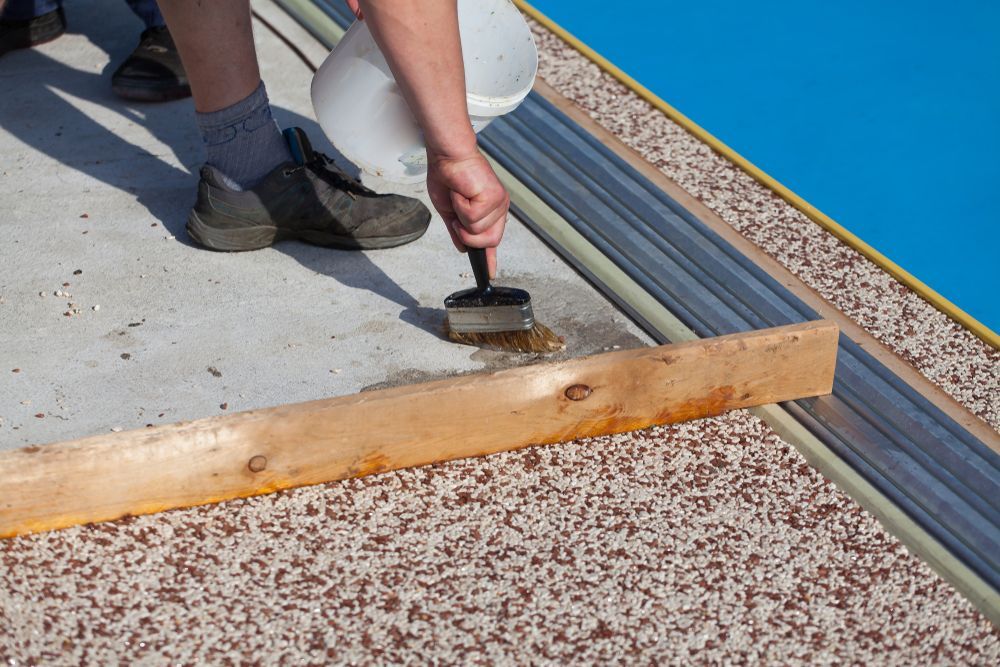
Each commercial application requires analysis of traffic patterns, chemical exposures, temperature ranges, and downtime constraints before selecting materials and scheduling work. Retail installations prioritize appearance and fast cure times to minimize closure periods, while industrial floors emphasize chemical resistance and mechanical strength over aesthetics. The coating formulation, thickness, and topcoat selection all adjust based on these priorities.
Once the system cures, your floor resists staining from hydraulic fluid, cleaning chemicals, food oils, and other substances that would permanently discolor bare concrete. The surface cleans quickly with standard equipment, reducing labor costs compared to scrubbing and resealing porous concrete repeatedly. High-traffic paths no longer show wear patterns that make the space look neglected, and the monolithic surface eliminates trip hazards from cracked or spalled concrete that create liability concerns.
Efficient installation with quality materials minimizes downtime by using fast-cure formulations where operations can't stop for extended periods. Temperature-controlled application ensures proper curing even during summer heat or winter cold in Perry, preventing soft spots or incomplete curing that reduce durability. Businesses gain floors that support operations rather than requiring constant attention, with performance measured in decades rather than years when preparation and material selection match the use case.
Questions Before Starting Your Project
Business owners and facility managers typically ask about installation timing, performance specifications, and how to select appropriate coating systems before committing to commercial flooring projects.
What factors determine which epoxy system works for specific commercial uses?
Chemical exposure types and concentrations, vehicle traffic weight and frequency, thermal cycling from equipment or climate control, and required slip resistance all influence base coat formulation, thickness, and topcoat selection.
How long does commercial epoxy installation restrict facility access?
Cure times range from 24 hours for fast-cure polyaspartic systems to 72 hours for heavy-duty epoxy systems, with full chemical resistance developing over seven days, so scheduling around operational needs and seasonal demand prevents revenue loss.
Why does contamination removal matter more in commercial settings?
Oil, grease, and chemical residues penetrate deeper into high-traffic commercial slabs than residential concrete, and any contamination left behind prevents the mechanical bond from forming, causing delamination when heavy loads or thermal stress hit the coating.
When do warranties cover commercial floor failures?
Coverage typically requires documented surface preparation including profile depth measurement, moisture testing results, and application within specified temperature and humidity ranges, with exclusions for damage from impacts, chemical spills outside the rated resistance, or inadequate maintenance.
What maintenance protocols extend commercial epoxy floor life?
Daily dust mopping or auto-scrubbing removes abrasive grit, prompt spill cleanup prevents chemical exposure beyond rated resistance times, and periodic recoating of high-wear paths maintains appearance without full floor replacement.
CS Custom Epoxy installs commercial flooring systems engineered for your specific operational environment, using materials selected for the chemical exposures, traffic loads, and performance timeline your facility requires. Contact us at (423) 231-8815 to schedule an on-site evaluation and discuss coating options that minimize downtime while maximizing floor performance.