Flooring That Survives Daily Industrial Demands
Warehouse and Industrial Floor Coatings in Perry for facilities experiencing chemical spills and equipment damage
Industrial facilities in Perry deal with constant traffic from forklifts, pallet jacks, and heavy equipment that gradually breaks down unprotected concrete through impact and abrasion. CS Custom Epoxy installs industrial floor coatings formulated to resist chemical exposure, mechanical wear, and surface damage that would otherwise require frequent concrete repairs. These systems are built using high-solids epoxy formulations and aggregate additives that create thickness and impact resistance beyond what residential coatings provide.
The coating process for industrial environments requires aggressive concrete preparation, often involving shot blasting or scarification to achieve the profile depth needed for maximum adhesion under heavy loads. Multiple epoxy layers are applied to build coating thickness, and topcoats often include aluminum oxide or other hardening agents that improve abrasion resistance. The result is a surface that handles daily operations without chipping, delaminating, or absorbing chemicals that would otherwise stain and weaken the concrete.
Schedule a facility assessment to evaluate current floor damage and discuss coating specifications.
What Changes After Industrial Coating Completes
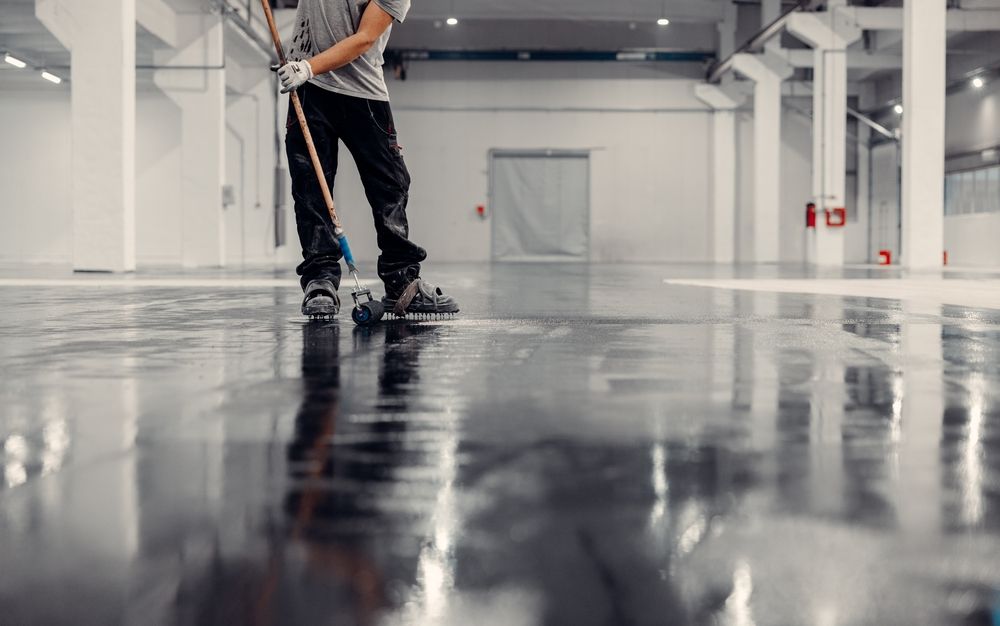
Installing warehouse coatings involves coordinating work around operational schedules since areas must be closed during preparation and curing. The concrete surface is mechanically profiled using equipment that removes weak material and creates an angular texture for coating adhesion. Cracks and control joints are routed and filled with semi-rigid epoxy to prevent them from reflecting through the coating. Base coats are applied at high build thickness, often exceeding 20 mils, followed by broadcast aggregates in high-traffic zones and clear topcoats that seal the system while maintaining chemical resistance.
After the coating cures, forklift traffic no longer leaves black tire marks that require constant scrubbing, and dropped tools or pallets do not chip the surface the way bare concrete does. Chemical spills from hydraulic fluid, oils, or cleaning agents sit on the sealed surface long enough for cleanup without etching or staining the floor. The coated surface also reflects overhead lighting more effectively than raw concrete, which improves visibility and can reduce lighting costs in large warehouse spaces. Sweeping and scrubbing become more efficient because dust and debris do not embed in the porous concrete texture.
Industrial coatings are specified based on the specific exposures each facility encounters. Warehouses with minimal chemical contact may use standard epoxy systems, while manufacturing plants with acid or solvent exposure require chemically resistant urethane topcoats. High-traffic drive aisles often receive thicker coatings or additional aggregate reinforcement compared to lower-traffic storage zones. Slip resistance is adjusted by varying the topcoat texture, with smoother finishes preferred for areas where pallets slide and textured finishes used where foot traffic requires traction.
Answers to Frequent Service Questions
Facility managers in Perry and the surrounding region often need clarity on coating durability and downtime before committing to installation.
What preparation is required for industrial floor coatings?
Concrete must be profiled using shot blasting or diamond grinding to remove existing coatings, oils, and weak surface material, creating a surface profile measured in mils that matches coating manufacturer specifications. Oil contamination is removed using degreasers and mechanical methods, since even residual oils prevent epoxy adhesion.
How do industrial coatings handle forklift and heavy equipment traffic?
High-build epoxy systems distribute impact forces across the coating thickness rather than concentrating stress at a single point, which prevents chipping and delamination. Coatings rated for industrial use are formulated with higher compressive strength and abrasion resistance than residential systems.
Why do some areas of the floor receive thicker coatings?
Drive aisles and equipment pathways experience concentrated wear that justifies additional coating thickness or broadcast aggregate reinforcement, while storage areas with minimal traffic can use thinner applications. This approach balances performance with material costs.
When can operations resume after coating installation?
Most industrial epoxy systems allow light foot traffic within 24 hours and full vehicular traffic within 72 hours, though cure times vary based on temperature and humidity in Perry's climate. CS Custom Epoxy schedules installations to minimize operational disruption by coating sections in phases when full facility closures are not feasible.
What chemical resistance do warehouse coatings provide?
Standard epoxy coatings resist oils, mild acids, and alkaline cleaning solutions, but facilities with strong solvents or concentrated acids require urethane or novolac epoxy topcoats that offer superior chemical resistance. The coating system is selected based on the specific chemicals present in your operation.
CS Custom Epoxy works with facility managers throughout Perry to install flooring systems that support demanding industrial environments. Arrange an on-site evaluation to discuss your facility's specific traffic patterns, chemical exposures, and operational requirements.